ByJohn A
How Top Silicone Prototype Manufacturers Streamline Product Testing and Reduce Time-to-Market for Medical and Industrial Devices
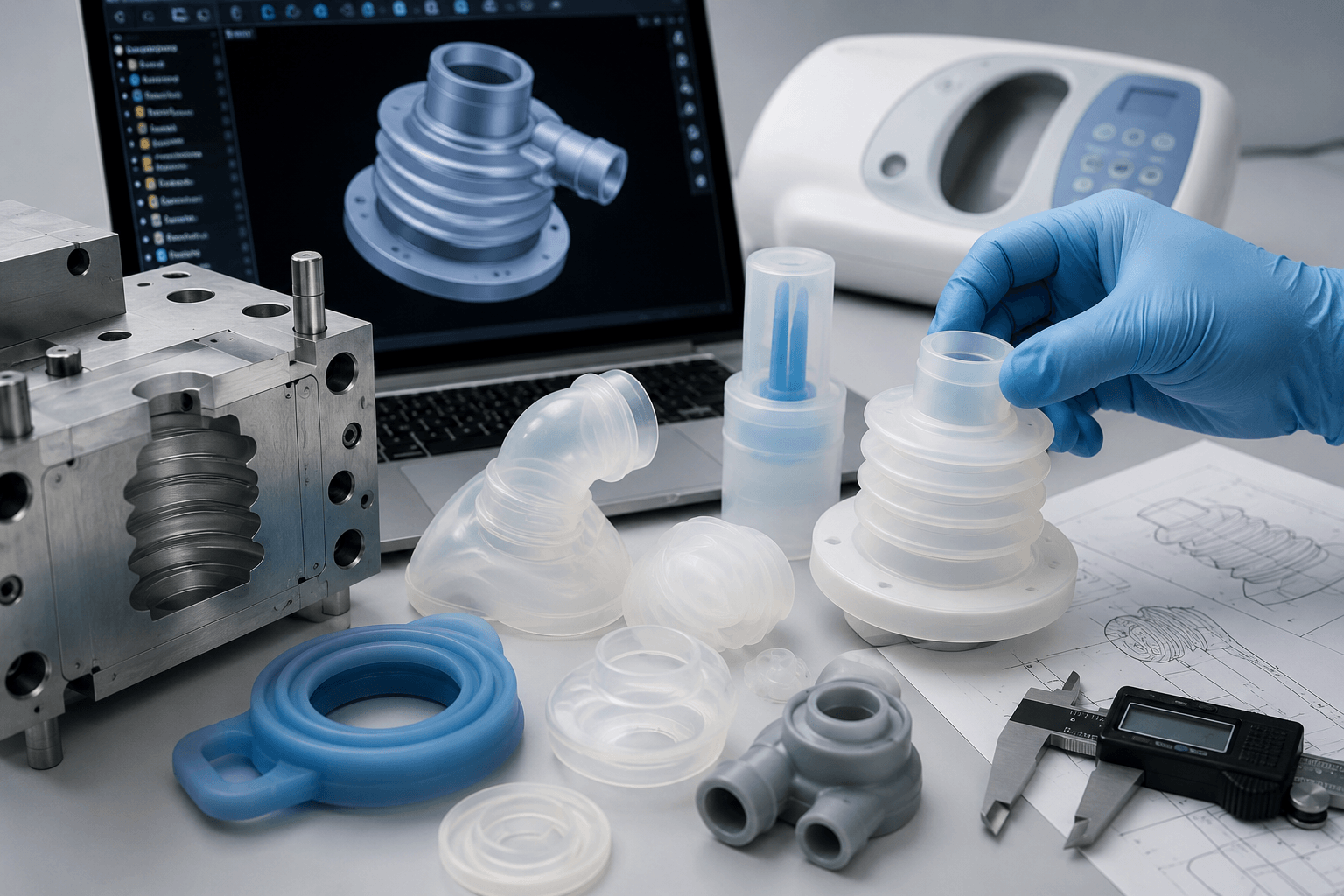
Leading silicone prototype manufacturers accelerate the development of medical and industrial devices through rapid prototyping, custom liquid silicone rubber (LSR) formulations, and advanced tooling. Partnering with an expert silicone products manufacturer ensures tight tolerances, regulatory compliance, and seamless scaling of mass production.
Key Takeaways:
- Rapid silicone prototyping reduces design iteration cycles from months to days.
- Custom elastomer formulations ensure strict biocompatibility and high thermal resistance.
- Prototype tooling lowers initial tooling expenses during early design validation.
- Direct bridge tooling guarantees smooth transitions into full-scale automated manufacturing.
The development of medical components and industrial seals often requires strict precision and durable materials. Rigorous functional validation is also a necessity. Early testing failures can often cause prolonged launch delays and costly tooling redesigns.
The Role of Prototyping in Medical and Industrial Device Development
Bringing new silicone devices to market requires rigorous testing under demanding operational conditions. Early physical validation prevents unexpected material failures and expensive tooling corrections during later manufacturing stages.
| Prototyping Method | Typical Turnaround Time | Tooling Cost Investment | Material Accuracy Level |
| 3D Printed Mold Inserts | 2 to 4 Days | Minimal Initial Cost | Moderate Thermal Match |
| Aluminum Bridge Tooling | 1 to 2 Weeks | Moderate Investment | High Functional Precision |
| Production Steel Tooling | 6 to 10 Weeks | High Capital Cost | Exact Production Quality |
Table 1: Comparison of Prototyping Approaches for Silicone Components
The above comparison table represents certain key trade-offs that include speed, cost, and accuracy, all necessary across common prototyping workflows. Choosing the correct prototyping methods can help engineering teams to balance speed and testing fidelity in the most effective way possible.
Accelerated Physical Design Validation
Engineers use functional prototypes to evaluate mechanical fit, seal compression, and fluid flow dynamics early. Working directly with top silicone prototype manufacturers enables fast design iterations without disrupting overall development schedules.
Evaluating Mechanical Seal Performance
Prototypes allow engineers to test compression set values under extreme temperature variations. Early testing ensures custom seals maintain structural integrity across real-world industrial environments.
Verifying Complex Geometric Tolerances
Modern medical devices demand tight tolerances across intricate micro-molded features. Quick prototyping systems verify dimensional stability before high-cavity production tooling can be finalized.
Risk Mitigation and Regulatory Compliance
Medical device components need to meet strict biocompatibility standards before being eligible for entering clinical trials. Early material validation reduces regulatory compliance risks during final product certification phases.
Conducting Biocompatibility Testing Early
Prototyping with medical-grade liquid silicone rubber guarantees early ISO 10993 compliance testing success. Validating raw materials early prevents costly reformulations right before commercial market launch.
Identifying Manufacturing Flaws Early
Physical testing uncovers potential molding defects like air entrapment or uneven flash. Resolving flow dynamics early ensures consistent output during mass production runs.
How Custom Formulations and Tooling Speed Up Production
Material selection directly impacts device longevity, chemical resistance, and mechanical performance under stress. Choosing an experienced silicone products manufacturer gives product designers access to specialized elastomer formulations.
| Elastomer Formulation | Key Physical Attributes | Target Industry Applications |
| Liquid Silicone Rubber (LSR) | High Clarity & Rapid Cure Speed | Medical Implants & Valves |
| High Consistency Rubber (HCR) | Superior Tear Strength & Durometer | Heavy Industrial Gaskets |
| Fluorosilicone (FSR) | Extreme Chemical & Fuel Resistance | Automotive & Aerospace Seals |
Table 2: Material Selection Criteria for High-Performance Applications
This material selection matrix highlights performance variations across the major categories of silicone elastomers. Matching physical properties to operational requirements can make sure of the long-term device reliability in the field.
Optimizing Tooling Strategies for Rapid Market Entry
High production tooling costs can lead to delays in project approvals during the initial phases of development. Rapid tooling solutions allow manufacturers to quickly produce functional parts for physical testing.
Aluminum Prototyping Molds
Aluminum molds lower initial tooling costs compared to hardened steel tooling. They deliver production-grade parts fast while allowing easy geometric modifications during design reviews.
Transitioning to High-Volume Production
Bridge tooling provides low-volume part supply while primary steel tooling is being built. Working with trusted silicone prototype manufacturers guarantees seamless scaling without compromising part quality.
Customizing Formulations for Demanding Environments
Industrial applications often require custom durometer levels, color matching, or specialty additives. Expert material engineers adjust base formulations to meet specific mechanical stress demands.
Enhancing Thermal and Chemical Resistance
Specialty additives improve resistance against harsh acids, solvents, and extreme heat. Custom compounding protects critical components operating in severe industrial processing environments.
Partnering with a Custom Silicone Products Manufacturer
Professional material selection eliminates premature component failures during final field testing. That is why collaborating with an established silicone products manufacturer can be essential to ensure continuous technical guidance throughout development.
Key Operational Protocols for Device Testing
Structured testing protocols ensure that every prototype can meet the correct guidelines for safety and performance. Implement these key steps for evaluation before making the switch for new device designs into commercial manufacturing:
- Validate raw material certifications, including FDA, USP Class VI, and ISO 10993 compliance.
- Test prototype parts under maximum stress parameters (thermal, chemical, and mechanical).
- Audit mold flow simulations to eliminate air traps and sink marks before tooling.
- Perform dimensional verification using high-precision optical measurement systems.
- Establish clear quality control thresholds for final low-volume bridge production runs.
See also: Technology Democratization in Enterprises
Final Thoughts
Accelerating product development requires combining rapid prototype tooling, precise material selection, and rigorous functional testing. Partnering with experienced manufacturing specialists eliminates design defects while protecting project budgets. Secure your market edge by optimizing your component development workflow today!
Accelerate Your Product Launch with Expert Manufacturing
Overcoming design challenges requires high-precision tooling technology paired with deep material expertise.
Access advanced liquid silicone rubber processing, custom compounding, and dedicated engineering support within one unified facility. Validate your product designs using fast prototype tooling before committing to high-volume manufacturing runs.